
For SBIC fund managers

Prepare and review the SBIC quarter in one workspace.

Preparation, calculation, reconciliation and review for Small Business Investment Companies (SBICs).

NSight Private Credit — SBIC Edition connects borrower financial intake, agreement-defined covenants, investment accounting, valuation workpapers, GAAP-to-SBA reconciliation, partner-capital schedules and SBIC reporting preparation.

  • Covenant tests for every borrower
  • GAAP-to-SBA bridge and capital impairment
  • ASC 820 marks for loans, equity and warrants
  • Form 468 with Schedule 12. Forms 480, 652 & 1031.

NSight prepares investment calculations, reconciliation workpapers and reporting outputs. Your team and specialist providers retain authoritative fund books, contractual allocations, investment judgments, signing and filing.

Complete a short form for instant access to the read-only demonstration.

Covenant monitor · Q3 2026Demo fund
Brakeholt Engineered Products Co.Total leverage, amended maximum 4.00×
4.20×Borrower certificate
4.50×Recomputed from the credit agreement
BreachMismatch 0.30×
Fixed charge coverageMinimum 1.50×
Borrower reports 1.60×Not tested

The financials lack inputs the agreement’s formula requires, so NSight does not accept the reported pass.

Two findings a copied certificate would hide. Illustrative borrower from the NSight demo. See the covenant monitor
Built for SBICs

SBA valuation basis, capital impairment, the GAAP-to-SBA bridge and Form 468 with Schedule 12 and Forms 480, 652 and 1031—built into one workflow from borrower intake to quarter-end review.

Built to own

A dedicated version tailored to your fund, hosted in your cloud or ours. You own the code permanently, with optional maintenance and support.

Save time. Add control

Reduce repetitive preparation and move your team toward exception review. Code calculates from agreement terms, figures link to their sources, and changes leave an audit trail.

Security and expertise

NSigma is ISO/IEC 27001 certified, with SOC 2 Type II assessment underway. Our co-founders each have nearly 20 years’ experience covering SBICs, BDCs and private-credit predictive analytics.

How the quarter runs today

Most quarters still run on workbooks, email and one person who knows how they fit.

Borrower packages arrive as PDFs and spreadsheets. Figures are re-keyed into monitoring, valuation and compliance workbooks. The administrator sends Form 468 schedules, the valuation firm sends marks, and someone reconciles it all by hand before the board pack goes out.

It holds together until someone asks where a number came from.

At quarter-endIn workbooks and outsourced filesNSightPrivate Credit
A borrower package arrivesSomeone opens the PDF and types EBITDA into three different workbooks.Extraction proposes each figure with the page it came from. An analyst confirms it once, and every schedule uses the confirmed value.
The SBA basis is dueThe administrator computes it and the team reviews a PDF.GAAP and cost reconcile to SBA value by position. Depreciation ties into capital impairment, and the computed figure is compared with what was filed.
A covenant is testedThe ratio on the compliance certificate is copied into the tracker.The ratio is recomputed from the agreement’s own definition and effective-dated threshold. The certificate stays beside it for comparison.

Your administrator, valuation firm and auditor stay in place. NSight prepares investment calculations, reconciliation workpapers and reporting outputs for independent review; your team and specialist providers retain the authoritative books, allocations, judgments, signing and filing.

SBIC edition

From the position to the fund.

The SBA basis is a rulebook, and NSight computes it like one. Cost rolls forward from Schedule 1c activity, collection in doubt is tested, GAAP and cost reconcile to SBA value by position, and depreciation carries into the 13 CFR 107.1840 capital impairment calculation.

15.14%Capital impairment, computed from reviewed fund inputs
45%Maximum permitted for this fund under 107.1830
29.86Percentage points of headroom

Illustrative demo fund, Q3 2026. GAAP value of $100.4M less $4.8M of appreciation above cost, and cost of $107.25M less $11.65M of SBA depreciation, both reach $95.6M of SBA value. The maximum depends on each fund’s equity mix and leverage.

SBIC quarter review · Actual demo screen, Q3 2026Open in the demo
Illustrative example: NSight SBIC quarter review. GAAP to SBA: GAAP 100,400,000 less appreciation above cost 4,800,000 equals filed SBA 95,600,000. Cost to SBA: cost 107,253,250 less SBA depreciation 11,653,250 equals 95,600,000, and the tie is confirmed. Depreciation carries into six capital impairment steps citing 107.1840(c) and 107.1830, ending at 15.14 percent against a 45 percent maximum with 29.86 points of headroom, confirmed by an independent reviewer.
Both reconciliations, then the impairment calculation step by step, with each regulation cited and an independent reviewer’s confirmation.

The checks, in plain words

Each check shows the submitted value, the computed value, the rule and the source page, then asks the reviewer to confirm, correct or explain. Every disposition is logged.

AreaWhat gets flagged
CostA loan carried above cost. Cost that does not tie to the Schedule 1c ledger. Collateral used to justify appreciation.
DoubtMore than 120 days past due, insolvency or going-concern doubt with no depreciation. PIK or accrued interest added while collection is in doubt. Status of Performing while Schedule 4 shows past due.
BasisGAAP value below SBA value. A mark that does not follow from its own stated assumptions. SBA cost and GAAP carrying value that differ with no attributed reason.
FundComputed impairment that differs from the filed figure. A fund within five points of its limit. Includible non-cash gains misclassified. Class 2 appreciation without a qualifying event.

Covenant review

The certificate says 4.20×. The agreement says 4.50×.

NSight reads the credit agreement to define each test, then calculates it from the borrower’s reviewed financials. The reported figure stays alongside the result, so a mismatch is recorded as a finding instead of being quietly corrected.

Covenant monitor · Actual demo screen, Q3 2026Open in the demo
Illustrative example: NSight covenant monitor for Q3 2026 with eight covenant rows. Brakeholt fixed charge coverage shows Unavailable against a 1.50 times minimum, status Not tested, reported 1.60 times, reconciliation Unable to verify. Brakeholt total leverage shows 4.50 times against a 4.00 times maximum, cushion negative 12.5 percent, status Breach, reported 4.20 times, reconciliation Mismatch.
1
2
Illustrative borrowers. Every row links to the definition, inputs and source behind the calculation.
1Fixed charge coverage

1.60× reported. Not tested.

The borrower reports 1.60× against a 1.50× minimum. The financials lack inputs the agreement’s formula requires, so NSight shows the calculation as unavailable. A reported pass does not stand in for a calculated one.

2Total leverage

4.50× calculated. 4.20× reported.

Applying the agreement’s definition gives 4.50× against an amended 4.00× maximum. The 0.30× mismatch and the breach are recorded as separate findings, each with its definition, inputs and source.

Track upcoming covenant step-downs.

Brakeholt’s senior leverage passes at 3.00× today, but its limit falls to 2.75× in Q2 2028. Unchanged leverage would exceed that limit by 0.25×, showing when debt reduction or earnings growth would be needed.

Actual senior leverageContractual maximumLeverage held constant

Illustrative scenario: leverage held constant.

Illustrative senior leverage and contractual maximum, Q2 2026 to Q2 2028 Actual senior leverage is 3.00 times in Q2 and Q3 2026. After Q3 2026, a shaded illustrative scenario holds leverage constant at 3.00 times through Q2 2028, not a forecast. The contractual maximum is 3.50 times until Q2 2028, when it steps down to 2.75 times. Leverage held constant would be 0.25 times above the scheduled limit.

Actual · Q2 and Q3 20263.00×

Contractual maximum3.50× → 2.75× in Q2 2028

Q2 2028 · Illustrative scenario0.25× above scheduled limit.

Illustrative covenant timeline.
Tests the Foundation supports

Total and senior leverage, minimum EBITDA, interest coverage, fixed charge coverage, springing tests, minimum liquidity with grace periods and excess-cash sweeps. Amendments are effective-dated. Waivers and cures are recorded beside the original breach and never replace it. Stress scenarios run separately from actuals.

How it works

ExtractionProposes.PeopleConfirm.CodeComputes.

Each layer does one job and never another’s. That separation is what makes a number reproducible when an auditor, an SBA examiner or your own board asks how it was reached.

Extraction
Finds and proposes

Reads borrower PDFs, workbooks and credit agreements. Proposes figures and terms with the page, units and period. It never computes a covenant, a mark or an impairment.

People
Confirm, judge and approve

Analysts check each proposed input against its source. Reviewers approve results, and nobody approves their own work. Investment judgment stays with your team.

Code
Calculates the same way every time

Deterministic rules compute covenants, loan schedules, SBA values and impairment. Each result stores its inputs, rule and engine version, and reruns without calling a model.

Who it is for

Built for the people who answer for the quarter.

Each role gets a different question at quarter-end. NSight answers from the same reviewed record, so the answers agree with each other.

Role

The question on your desk

Does the Form 468 output tie, and can we show why?

What NSight puts in front of you

Investment calculations, GAAP-to-SBA reconciliation, capital impairment and partner-capital schedules, alongside Form 468 with Schedule 12 and Forms 480, 652 and 1031.

Also running a BDC or a direct lending fund? See how the same record serves them.

Platform

One Foundation. Four modules.

Every deployment starts with the Foundation. Add the modules your fund needs; Modules 3 and 4 make up the SBIC edition.

RequiredFoundation

Collect borrower reporting, confirm source-linked financials and recalculate agreement-defined covenants. Track amendments, waivers, cures and stress scenarios, with independent review and retained history.

Any credit fundModule 1

Loan valuation and accounting

Bring loan valuation and investment accounting together: interest earned versus received, PIK, supported OID and fee accretion, carrying values and proposed marks alongside approved valuations.

Any credit fundModule 2

Equity and warrants

Track ownership, investment events, proceeds and marks, with MOIC and dated equity XIRR from sourced cash flows, plus supported warrant intrinsic-value checks.

SBIC editionModule 3

SBA valuation and reconciliation

Reconcile investment cost and GAAP value to SBA value, with depreciation, collection-in-doubt findings and source-linked exceptions ready for review.

SBIC editionModule 4

Fund oversight and reporting

Prepare impairment and headroom calculations, partner-capital roll-forwards and SBIC reporting: Form 468 with Schedule 12, Forms 480, 652 and 1031 preparation, and board/credit packs.

What you hand over at quarter-end

OutputContentsFrom
Credit reviewCovenant results, relief, headroom and review evidenceFoundation
Loan schedulesSupported cash-interest, PIK, OID, fee and carrying-value schedules.Module 1
Valuation supportApproved marks, evidence and quarter-to-quarter explanationsModule 1

Controls

Built to be checked by someone else.

The controls sit inside the workflow, so the record is already complete when the quarter closes. A workbook cannot show who typed a number or whether this quarter’s formula matches last quarter’s.

Missing stays missing

An unknown figure is never shown as zero, so a gap never reads as compliant.

Not tested beats a guess

Without every input a definition needs, the result says Not tested.

No one approves their own work

Whoever prepared an upload, calculation or mark cannot confirm it, whatever their role.

The issued quarter is never overwritten

Corrections create a reviewed replacement. The original pack, workbook and PDF stay retrievable.

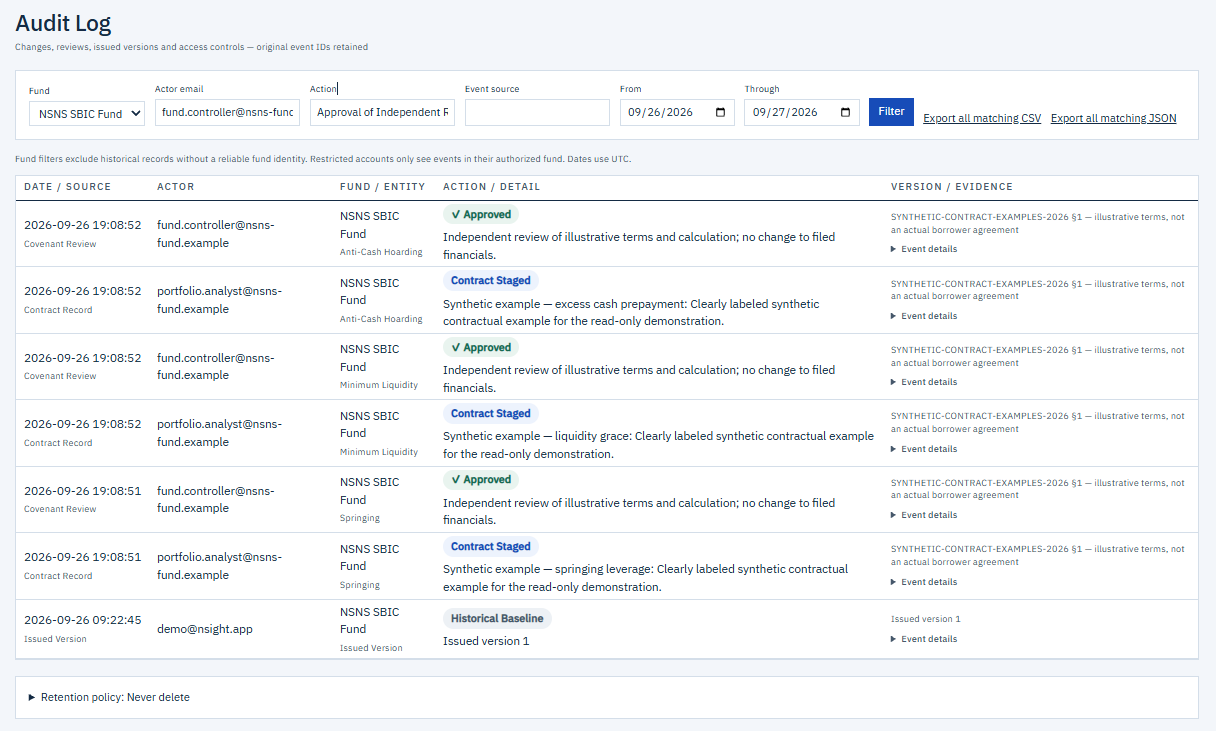
The audit history records who changed what, when and why, with source and version references. Export the scoped history as CSV or JSON for your auditor or an SBA examination.

Audit log · Actual demo screenOpen
Illustrative example: NSight audit log. A portfolio analyst stages contractual terms for excess cash, liquidity grace and springing leverage, and a fund controller separately approves each one, with timestamps, entity identifiers and version references.
An analyst stages each contractual term; a controller approves it separately. Illustrative entries.

Your options

Three ways to run the quarter.

Most funds choose between keeping the current process and renting a platform. NSight is a third option: software built on your book that your fund keeps.

Workbooks and outsourced filesSubscription software as a serviceNSightPrivate Credit
Where the logic livesIn workbook formulas and the people who maintain themIn the vendor’s product, configured to your fundIn versioned code, deployed for your fund
Covenant testingCertificate figures, copiedVaries by product; often monitoring and alertsRecomputed from the agreement, certificate kept beside it
SBA basis, impairment and SBA formsAdministrator workpapers the GP reviewsUsually outside a general private credit platformBuilt in: bridge, impairment, Form 468 with Schedule 12, and Forms 480, 652 and 1031 preparation

A general description of each approach, not a review of any named vendor.

Ownership

Built on your book. Yours to keep.

A one-time build for your fund’s dedicated instance, then an optional monthly service. No seat licences, and your right to use your version continues if a service plan ends.

What the build includes

  • A dedicated instanceDeployed in your cloud or ours. Your data is never pooled with another fund’s.
  • Configuration to your fundYour credit agreements, instruments, valuation policy, review roles and reporting outputs.
  • Your book, loadedExisting credits onboarded, with the prior quarter in place so movements are real from day one.
  • A handover your team can runTraining to add new credits, client IT responsibilities and a rehearsed backup and restore runbook.

Target production delivery is within 90 days of receiving complete credit documentation and data.

Optional monthly service, after go-live

Maintain

Security, dependency maintenance, defect correction, controlled releases and technical support.

Managed Care

Maintain, plus regulatory and accounting change management, calculation validation, quarter-end help and a named service owner.

Managed Operations

Managed Care, plus recurring intake checks, exception triage, administrator coordination and reporting-pack preparation.

Managed hosting is available. Service scope is agreed for your engagement, and your team keeps every approval.

How an engagement runs

  1. 01Scope

    Credits per fund, vehicles and leverage, instrument types, who prepares and who reviews, and your valuation policy.

  2. 02Intake

    Credit agreements, servicing statements, borrower financials, your position ledger, filed Schedule 1 and valuation memos.

  3. 03Pilot, optional

    Three credits across two quarter-ends, including one on watch. Every difference from your filed numbers is shown with its rule and page.

  4. 04Full book

    Every active credit and vehicle, with the prior quarter loaded so movements are real from day one.

  5. 05Handover

    Upload training, client IT responsibilities, a rehearsed backup and restore runbook, and recorded acceptance in your environment.

BDCs and lenders

Built for SBICs. Ready for the rest of your platform.

Many SBIC managers also run a BDC, a direct lending fund or a mezzanine fund beside the licensed vehicle. The Foundation and Modules 1 and 2 serve those funds today, on the same reviewed record.

Full SBIC edition

BDCs with SBIC subsidiaries

Support the SBIC subsidiary with SBA valuation, capital impairment and Forms 468 and 1031 preparation. Scope the parent’s credit workflows and reporting requirements separately.

Foundation + Modules 1 and 2

BDCs

Agreement-defined covenant monitoring, supported loan accounting, valuation workpapers and position-level evidence. BDC asset-coverage, qualifying-asset and RIC tests are additional client-specific scope.

Foundation + Modules 1 and 2

Direct lenders and mezzanine funds

Covenant review, loan valuation and accounting, and equity and warrants for funds that co-invest. No SBA modules and no SBA vocabulary in the way.

Tell us which vehicles you run and we will scope the modules that apply to each.

Next step

Start with a quarter you’ve already closed.

You already know the answers, which makes it a fair test. Choose a few borrowers and fund workpapers, and we reproduce them in NSight in front of your team.

Talk to the NSigma team info@nsigma.io
  1. 01Agree the scope

    Pick the borrowers and workpapers to reproduce, including one that is delinquent or on watch.

  2. 02Compare the results

    Check every figure against your own schedules. You decide which differences are corrections and which are explanations.

  3. 03Decide the next phase

    Agree acceptance criteria, modules and deployment, or stop there.

Acceptance is agreed in advance: input coverage, calculation tolerances, independent approvals, missing-evidence handling, issued history and reporting.

Before we talk

Questions CFOs ask first.

Scope, stated plainly

NSight supports investment calculations, reconciliation and reporting preparation. Authoritative fund books, contractual allocations and carry, payment execution, investor servicing, tax and independent audit remain with the fund or its providers. Authorized parties retain signing and filing responsibilities.

Supported instruments, conventions and methods are listed in the published scope matrix.

Which SBA forms does NSight support?

Form 468 with Schedule 12. Forms 480, 652 & 1031. Forms 480 and 652 support draft preparation; Form 1031 supports assembly, review and versioned export preparation, subject to package acceptance. Your fund’s input mapping, applicable sections and generation process are agreed and validated during implementation. Authorized parties sign and submit externally.

Does NSight replace our fund administrator?

NSight supports investment calculations, reconciliation and reporting preparation. Authoritative fund books, contractual allocations and carry, payment execution, investor servicing, tax and independent audit remain with the fund or its providers. Authorized parties retain signing and filing responsibilities.

Is it a SaaS subscription?

No. NSigma builds a dedicated instance for your fund, in your cloud or ours, for a one-time build fee. Your right to use that version continues if a service plan ends. Hosting, maintenance and support are optional and scoped separately.

What exactly does the extraction model do?

It reads borrower documents and credit agreements and proposes figures and terms, each with its source page. An analyst confirms or corrects every one. All calculations are deterministic code and rerun from stored inputs without calling a model.

Where does our data go during extraction?

In a client deployment, extraction can run through a model account in your name or inside your own tenancy, or be switched off in favor of manual mapping. Each deployment is a dedicated instance, and its data flows are documented for your security review.

Is it only for SBICs?

SBICs come first, and the SBIC edition is where NSight goes deepest. The Foundation and Modules 1 and 2 also serve BDCs, direct lenders and mezzanine funds. BDC-specific tests such as asset coverage and the 70% qualifying-asset test are scoped with each client.

Does NSight file Form 468 or Form 1031?

No. NSight supports Form 468 with Schedule 12 and Forms 480, 652 and 1031. Form 1031 exports are independently approved and retained. Signing and SBA submission stay with you or your filer, and NSight records Approved, Exported, Signed and Submitted as separate states.

What should we validate for our SBA reporting path?

For your fund, agree the generation path, input mapping, applicable forms and schedules, and acceptance criteria, then evaluate a completed quarter against your workpapers. Forms 480 and 652 support draft preparation; Form 1031 supports assembly, review and versioned export preparation, subject to package acceptance. Your team and filer review and approve the package before signing and submission.

How long does deployment take?

The target is production delivery within 90 days of receiving complete credit documentation and data. Most of that time depends on how quickly documents and prior-quarter data arrive.

How do we evaluate it?

Choose a completed quarter and a small set of borrower packages and fund workpapers. We agree the scope and acceptance criteria, reproduce the outputs, and compare them with your schedules line by line.